Clean and refill a hummingbird feeder every other day in warm weather, at least twice a week in summer heat, and once a week in the cool stretches of spring and fall. Fill it with 1 part refined white sugar to 4 parts water — one cup of sugar in four cups of water — and nothing else. Those three numbers (the ratio, the warm-weather interval, the cool-weather interval) are the whole skeleton of feeder observation. Everything else is about noticing what the birds and the feeder are telling you between cleanings.
The 4:1 ratio and why anything else is a mistake
Use 1 part refined white sugar dissolved in 4 parts water. That is the standard recipe, and it is standard because it approximates the sucrose concentration of natural flower nectar closely enough that birds can drink it without either running a deficit or taking in a syrup that gums up their bills. One cup of sugar into four cups of water is the batch most people make; scale it up or down but keep the proportion exact.
The reason to be strict is viscosity and spoilage, not sentiment. A stronger mix does not "give them more energy" in any useful sense — it makes the liquid thicker, harder to draw up through a feeder port, and faster to grow things in once the temperature rises. A weaker mix shortchanges the calories the bird came for. The 4:1 concentration is the balance point that has held up in practice for decades.
Refined white sugar only. Not turbinado, not raw, not honey, not agave, not the red dye that some people still add out of habit. Honey in particular is a genuine hazard — it carries a risk of fungal contamination that hits small birds hard, and it ferments differently from sucrose. Red dye serves no purpose except to reassure the human. The birds find the feeder by sight of the feeder itself and by the comings and goings of other birds.
The cost of getting this right is trivial: a bag of white sugar is cheap and lasts a long time. The cost of getting it wrong is a feeder that either spoils faster than you can keep up with or quietly harms the birds you were trying to help. There is no middle path here worth taking.
Cleaning frequency: the schedule and the exceptions
Every other day is the working default for a feeder in active use, and it is the interval that keeps mold from getting a foothold. In hot weather — real summer heat, not a mild afternoon — treat at least twice per week as the floor and every other day as the target. In cooler weather, spring and fall, once per week is the maximum you should let a complete cleaning and refill go.
The reasoning is straightforward. Nectar is sugar water, and sugar water is a growth medium. Warmth accelerates fermentation and bacterial bloom; a feeder sitting in direct sun on a hot day can go cloudy and start smelling fermented well inside the interval you'd tolerate in April. The birds will often tell you before you notice — a feeder that was busy goes quiet, or a bird approaches the port and veers off. When that happens, don't wait for the calendar; empty it, wash it, refill it.
"Complete cleaning" means disassembled. The reservoir, the base, the ports, the feeding flowers, the ant moat if you use one — all of it apart, all of it scrubbed. A rinse-and-top-off is not a cleaning, and doing it repeatedly is how you build a biofilm that you can't see but the birds can taste. Hot water and a bottle brush handle most of it. Skip the dishwasher unless the manufacturer says the parts are safe in it; heat warps the cheap plastic bases that most feeders use and a warped base leaks.
The exception that catches people: a feeder that empties faster than the schedule. In peak season with a busy feeder, you may be refilling daily anyway, and a refill is a free cleaning if you do it properly. The failure mode is the opposite — a feeder that doesn't empty, sitting half-full for a week because you assume the birds are just elsewhere. That's the one that spoils. Empty it, clean it, and put out a smaller volume until the traffic justifies more.
Placement decides how often you'll be cleaning
Shade cuts your cleaning frequency more than any product you can buy. A feeder in full afternoon sun will spoil faster than the same feeder under a porch roof or the north side of a tree, and the difference is large enough to change your schedule in practice. Put it where you can see it from a window — observation value is the point — but bias toward morning sun and afternoon shade if you have to choose.
Distance from windows matters too, and it's the thing people get wrong in both directions. Too close and birds flush when you move inside; too far and you can't see detail without binoculars you won't always have at hand. Somewhere in the range where you can watch comfortably without pressing your face to the glass is the compromise, and it's worth moving the feeder once or twice in the first season to find it. Hummingbirds are territorial and will re-find a moved feeder within a day or two, so the experiment is cheap.
Ants are the other placement variable. An ant moat — a small water cup on the hanger — is the standard fix and works well, but it needs refilling and it needs cleaning along with the rest of the feeder. If ants are already on the feeder, the moat won't help until you've cleaned the ports, because they're following a trail to residue. Some people grease the hanger; that works but it's messy and it can trap small insects you'd rather not kill. Water in a moat is cleaner and cheaper.
Wasps and bees are a separate problem with a placement answer: feeder ports that leak, or a feeder that's been knocked and dripped, draw them in. A feeder with a good seal and a bee guard reduces the traffic. If you're getting swarmed, the fix is usually cleaning the outside of the ports and checking that the base isn't seeping, not moving the feeder.
Reading bird behavior: what the feeder tells you
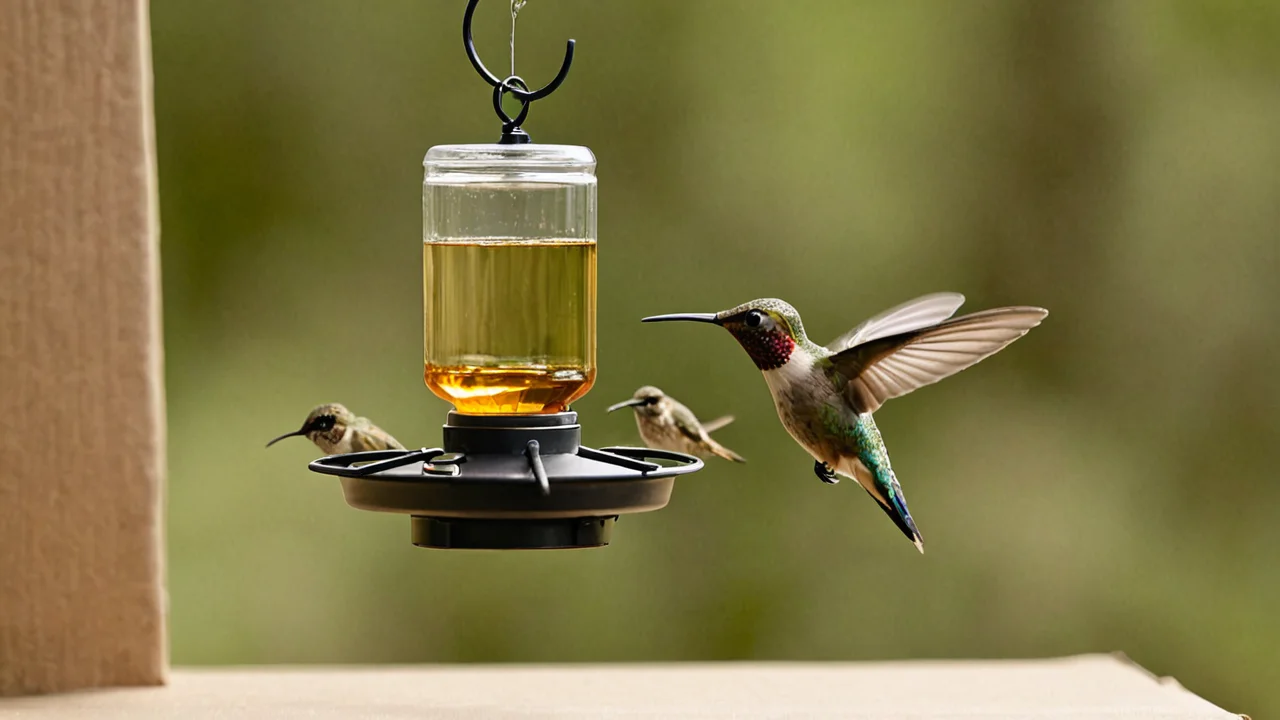
Watch the ports, not the feeder. A hummingbird that hovers, approaches, and pulls back without drinking is telling you the nectar is off — too old, or the port is contaminated. A bird that drinks and then shakes its head or wipes its bill on a branch is often dealing with a sticky or thick mix. Fresh, correctly made nectar gets a clean, unhurried drink.
Territorial behavior is the other thing to read, and it's where a lot of people misdiagnose. One aggressive male can dominate a single feeder completely, chasing off everything else and making it look like you have one bird when you have six. The observation tip is to count arrivals over a fixed window rather than watching continuously — sit for a while at the same time each day and tally how many distinct birds actually reach the port. If the answer is one, add a second feeder out of the first bird's sightline. That's the cheapest fix and it works better than any deterrent.
Activity has a rhythm worth learning. Hummingbirds feed heavily at dawn and again in the late afternoon, and midday traffic is often thinner. If you're trying to observe rather than just host, those two windows are when you'll see the most birds and the most interaction. The corollary is that a feeder that looks abandoned at noon may be perfectly fine.
What you can't reliably read from behavior is spoilage that hasn't yet driven birds off. Birds tolerate a surprising amount before they refuse a feeder, so behavior is a supplement to the schedule, not a replacement for it. Clean on the calendar; use behavior to catch the cases the calendar misses.
Observation technique: seeing more without more gear
Sit still and let the birds come to a fixed point. Hummingbirds habituate to a stationary human faster than most people expect, and the single biggest improvement most observers can make is to stop moving — no shifting in the chair, no raising the binoculars while a bird is at the port. Set up, get comfortable, and wait. The feeder does the attracting; you do the not-scaring.
Binoculars help but they're not the first purchase. A feeder placed at a comfortable distance in good light, viewed from a chair with your back to a wall so you're not silhouetted in a window, gives you more than a mediocre pair of binoculars used badly. When you do buy, close-focus capability matters more than magnification for feeder watching — you're often looking at something a few yards away, and binoculars that won't focus that near are useless for it. A monocular is a reasonable, cheaper alternative and easier to keep by the window.
Keep a simple log. Date, time, how many birds, what they did, and what the feeder looked like when you cleaned it. The log is what turns watching into observation: it tells you when traffic actually peaks in your yard, how long a batch of nectar lasts before the birds lose interest, and whether the schedule you've set is matched to your climate. Two weeks of notes will tell you more about your own feeders than any general recommendation can, including the ones on this page.
The trade-off is time. Careful observation means committing to a sitting, and a sitting means not doing something else. Most people find the dawn window is the one worth protecting because the light is good and the birds are hungry, and the late-afternoon window is the fallback when mornings aren't available.
Seasonal adjustments and the mistakes that cost birds
Shift the schedule with the temperature, not the calendar. Summer heat means at least twice-weekly cleaning and ideally every other day; the cool weeks of spring and fall mean once a week is the ceiling. The transition periods are where people get caught — a warm spell in late spring will spoil a feeder on a winter schedule, and a cool snap in early fall will make you over-clean a feeder that didn't need it. Watch the forecast, not the month.
In sustained heat, consider putting out less nectar per filling. A smaller volume that gets drunk and refilled every other day beats a full reservoir that sits and spoils. The feeder doesn't care about being full; the birds care about it being fresh. This is the single most useful adjustment for anyone in a hot climate, and it costs nothing.
The classic mistakes, in rough order of how often they happen: leaving nectar in past the interval because the feeder looks fine (it isn't — spoilage is often invisible until it isn't); topping off instead of cleaning; using a stronger mix thinking it's a kindness; adding dye; and letting a feeder hang empty through a cold snap and then refilling it with old nectar from the fridge. Made nectar keeps in the refrigerator for a few days, but not indefinitely, and it should go out at room temperature, not cold.
Freezing is a winter question in cold climates, and the honest answer is that it's more trouble than most people want. Frozen nectar doesn't feed anyone, and swapping feeders in and out through the day is a commitment. If you're going to do it, do it with two feeders and a rotation, and accept that you'll be cleaning more, not less, because freeze-thaw cycling degrades the nectar. For most observers in most of the country, the hummingbird season simply ends, and the right move is to clean the feeder thoroughly, dry it completely, and store it until the birds come back.
The through-line across all of it: the feeder is a piece of equipment with a maintenance schedule, and the observation is what you get for keeping to it. Get the ratio right, clean on the interval the weather demands, place it where you can actually watch it, and sit still. The birds will handle the rest.